How it all started…
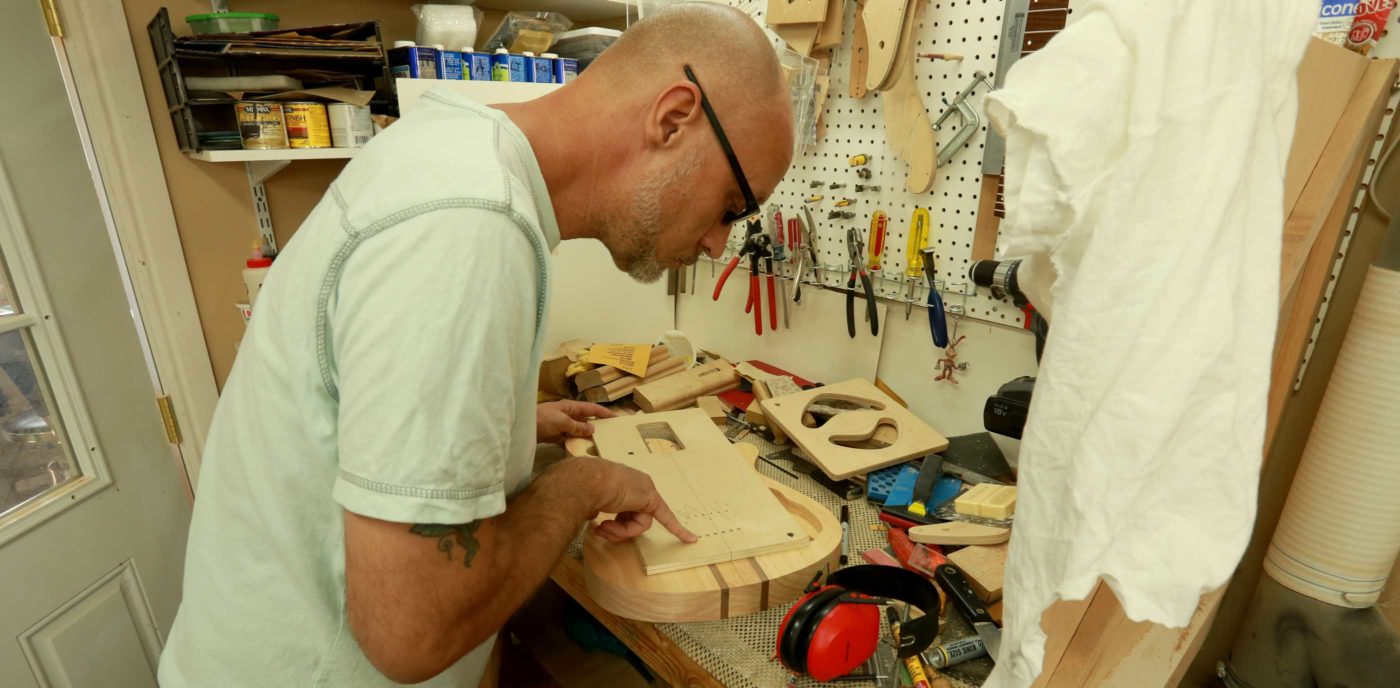
As a kid I would take things apart and tinker around, modify, and repaint stuff. Once I started playing guitar, I did the same to my guitars. Hot rodding them, painting them, just making them play better, and my friends started asking me to do the same to their guitars. So, it just kind of grew from there. I cut my teeth buying necks and bodies from other sources and building custom guitars that way. Then one day I looked at a guitar body and said “If I had a band saw, a router, and a drill press, I could make these myself.” I took woodshop 101 in Junior High and High School so I had an understanding of what I needed to do. I bought some tools and I was off and running. I had some early body designs drawn up in ’89 that a friend cut out for me. All my designs spawned from those designs. By the mid 90’s I was up and running under the name Joe’s Guitars. Yes I know my name is not Joe, Joe was my Dad who helped me get my start. The other reason for the Joe’s name is this, in the mid 80’s, as I sat in Guitar Center in San Jose, CA, playing a riff that I thought I knew pretty well, one of the employee’s walked by and said “Who do you think you are, Joe guitar player?” So years later I’m sitting there working on guitars in my garage, listening to Frank Zappa’s Joe’s Garage, that story came back to me and I thought Joe’s Guitars, now everyone can be a Joe Guitar Player! LOL!
Anyway, I’m naturally a creative person and with my designs I’ve always tried to build something comfortable, that feels like home, and is well balanced, using the best sounding woods. I really love building guitars and seeing the joy and excitement in a customer when they play them. With Joe’s Guitars I had several designs, and I did a lot of custom builds. One design known as “The Diner”, originally shown in Guitar and Bass Buyers Guide ’96, caught the attention of well-known amp builder Bruce Zinky. Bruce asked me to turn his roasted ash Telecaster body into a Diner guitar. The guitar body was a little warped and charred from being in an actual fire. I took on the project and it turned out great. In October of 2005 he contacted me and told me that he had bought the rights to the Supro brand and asked if I could build a few new Supro guitars to take to NAMM in January of 2006. He sent me the original 1956 template pattern for the body known as the Belmont design. From there I crafted new templates and jigs for the famous Supro neck pocket design. In that short 3 month span I built the guitars for the show. What I learned from that job was how I could speed up my own builds using such templates. This was not how I had done my builds before. I wanted a production model that I could do in this manner. I had an earlier short scale bass design known as the SS bass in my Joe’s Guitars lineup and I decided this would be the look for new line that became String King Guitars.